AI Is Coming for the Tomato
For a long time, the “future of food” was discussed like a restaurant concept: vertical farms, lab-grown meat, smart kitchens, protein with better branding. But food production has a less fashionable problem. Someone still has to harvest the crop.
THE REVELATION
Agricultural robotics is a reminder that automation is often driven by scarcity before it is driven by novelty. Eternal.ag is not building a tomato-harvesting robot because agriculture needs a futuristic image. It is responding to a labor bottleneck in greenhouse production, where repetitive physical work still limits scale. Its simulation-first approach also shows how AI and robotics are converging: machines can train in virtual environments, act in the real world and feed experience back into the system. The important question is not whether a robot can pick one tomato. It is whether it can repeat the task correctly for hours, across changing crops, at economics that make food production more resilient.
For a long time, the “future of food” was discussed like a restaurant concept: vertical farms, lab-grown meat, smart kitchens, protein with better branding.
But food production has a less fashionable problem.
Someone still has to harvest the crop.
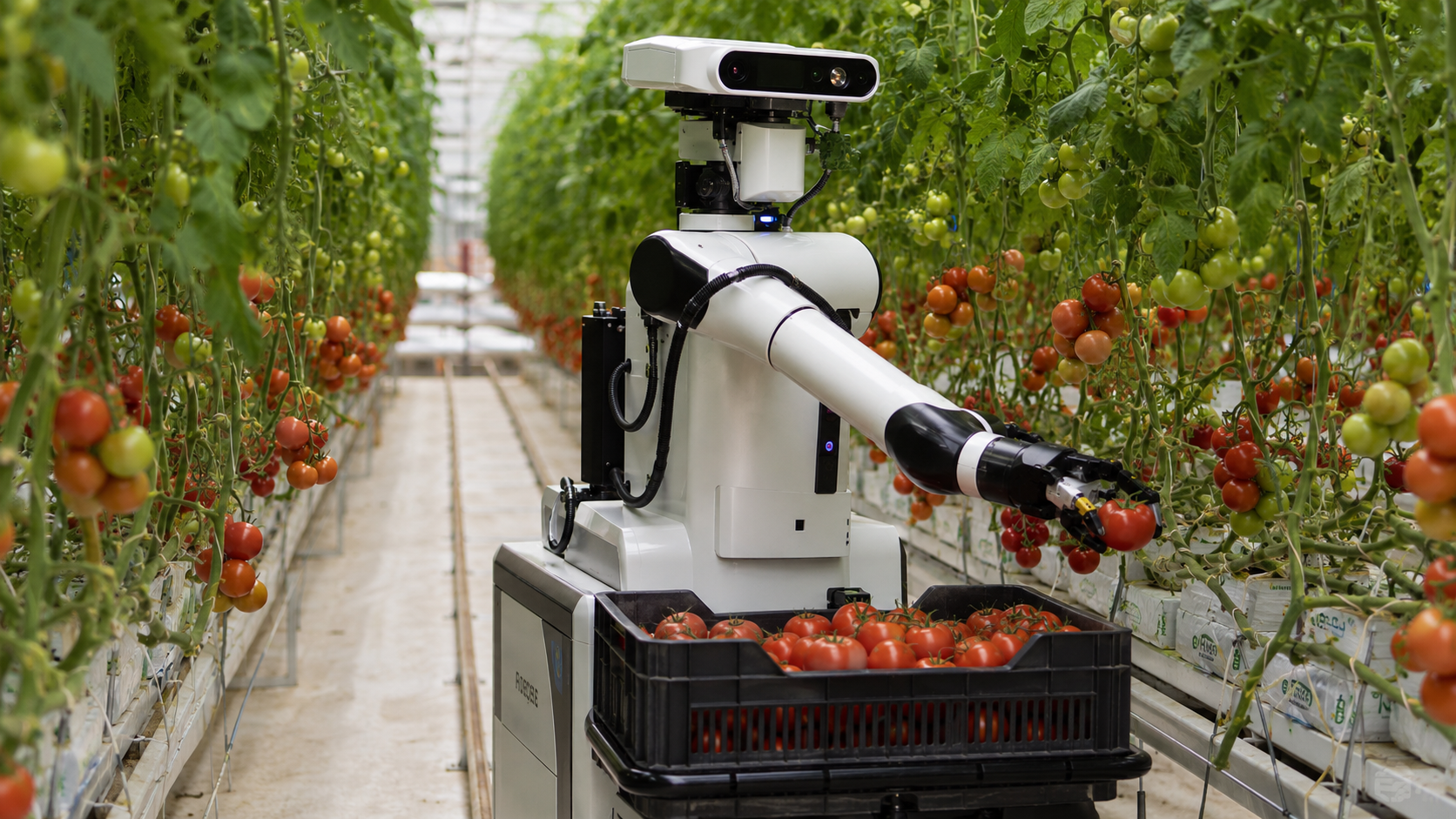
German agritech startup eternal.ag is building autonomous harvesting robots for greenhouses and has announced €8 million in funding to develop its technology. Its first commercial product is Harvester, a fully autonomous robot designed for tomato greenhouses. The company says Harvester can operate up to 22 hours a day and works as part of an AI-powered system to ensure produce quality and cutting consistency.
This is where AI becomes physical in a very practical way.
Greenhouses are increasingly important for year-round fresh food supply because they are more resilient to seasonal weather, climate change, land shortages and pests than outdoor farming. But eternal.ag points to a major bottleneck: labour availability in European greenhouses has fallen sharply, creating structural staffing shortages.
In other words, the robot is not being built because it looks good in a launch video.
It is being built because the food system is running into a human labour problem.
The company says its robots perform greenhouse crop work without human operators, and that by 2040 it envisions fully automated greenhouse operations requiring no manual work.
That is an ambitious vision. But the most interesting part is how the robot learns.
Eternal.ag says it uses simulation-first development, training and testing robots in virtual greenhouses before deployment. Once deployed, every robot action feeds data back into the system so it can learn, improve and scale.
This is not AI replacing “knowledge work.”
This is AI entering agriculture, one of the oldest physical systems humans ever built.
The tomato does not care about disruption. It cares whether it is picked correctly, at scale, again and again.
The future of food may not look like a futuristic city farm with perfect lighting.
It may look like a robot that can work almost all day, make clean cuts and never call in sick.