
The Dodo Is Only the Hook: Colossal Wants AI to Choose Biology’s Next Experiments
Colossal Biosciences says its GenoMorph platform uses AI to prioritize gene-editing targets in biological systems with limited genomic data. The dodo is the headline. The larger story is the software-to-lab pipeline taking shape around programmable biology.
THE REVELATION
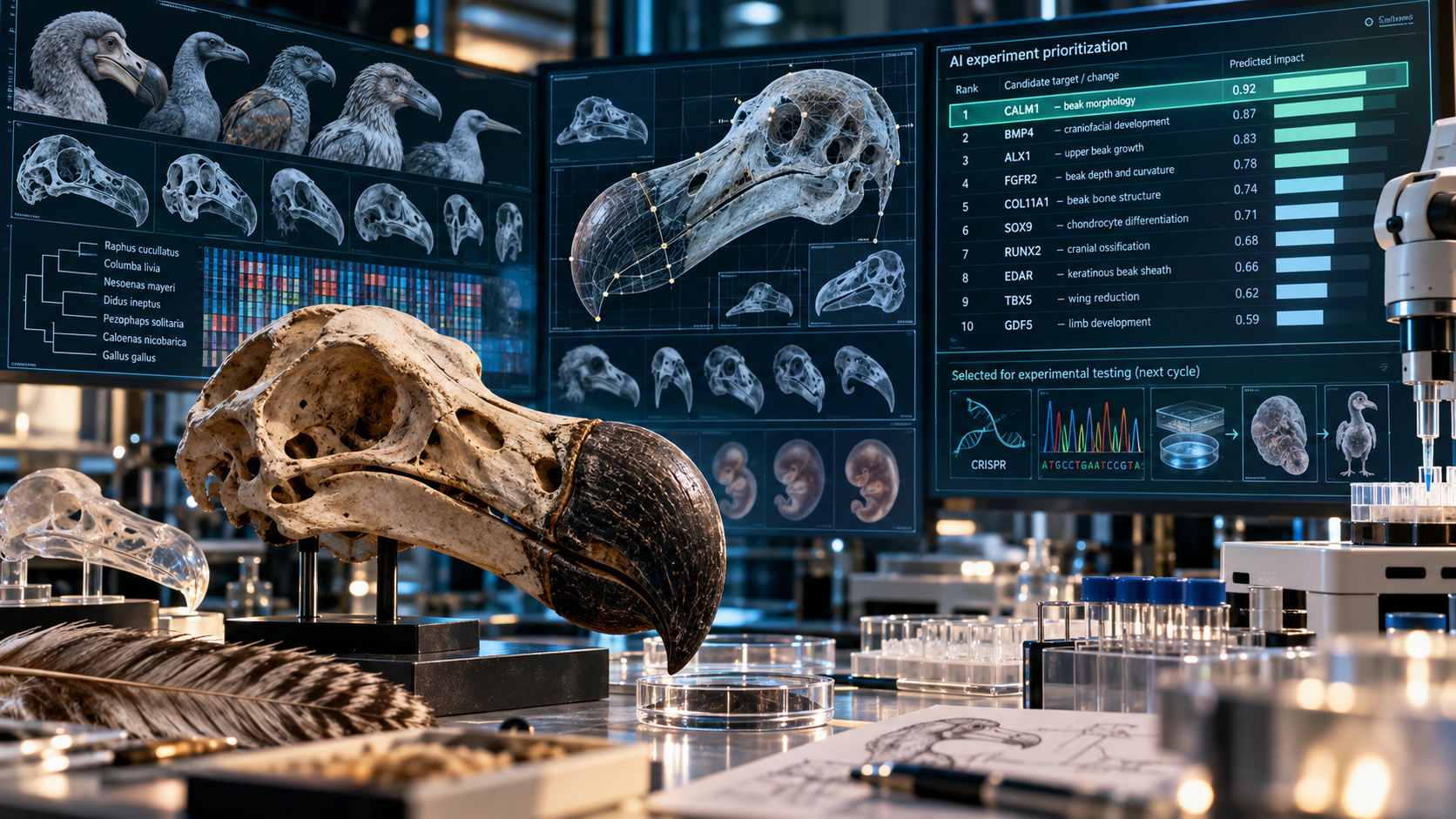
Colossal’s new AI is not a dodo-resurrection machine. It is a system for deciding which genetic experiments scientists should test first. GenoMorph ranks possible gene-editing targets rather than claiming to have identified the causes of a trait. That distinction matters: one of AI’s most useful roles in biology may be not to produce an answer, but to narrow thousands of biological possibilities into a smaller set of experiments worth running in the lab. The dodo makes the story spectacular, but the technology points much further. If this approach proves reliable, the same kind of decision layer could be applied across health, agriculture, conservation and synthetic biology. The ambition is clear. What still has to be proven is whether the system consistently chooses the right experiments.
The dodo is doing what extinct icons do best: attracting attention. But Colossal Biosciences’ new AI platform is really about something less cinematic and potentially more consequential – deciding which biological possibilities deserve a place in the lab.
Announced by Colossal on October 14, 2026, GenoMorph is described as an internal AI-powered system that prioritizes potential gene-editing targets when genomic data are limited. The company says it brings together comparative genomics, developmental biology and high-resolution 3D morphology. In other words, the system is positioned as a filter for experimental hypotheses, not a machine that has solved de-extinction.
A shortlist, not a resurrection
Colossal reported 2,351 candidate regulatory elements associated with dodo-like beak traits: 653 linked to beak size and 1,698 linked to thickness and breadth. The important qualifier is easy to lose beneath the number. These are prioritized candidates for experimental testing, and the company says the findings do not establish causation.
The reported inputs are substantial in variety: embryonic samples from chickens, quail, ducks and pigeons, alongside genomes and CT-derived skull measurements from more than 70 bird species and 541 anatomical landmarks. Those details describe the company’s reported approach, not independent confirmation of the platform’s performance.
Colossal also reported developing a lipid-nanoparticle delivery platform for DNA, RNA and CRISPR tools in developing bird embryos, including work involving rock dove and duck embryos. The company said a related manuscript had been submitted to bioRxiv; the supplied evidence does not establish peer-reviewed validation or readiness for practical de-extinction.
The bigger business hiding behind the dodo
The investment context widens the frame. A Form D for NeoGenesis Capital Fund I identifies Peter Harry Diamandis as executive officer and director, records a first sale date of June 18, 2026, and reports $33.08 million sold as of the filing. Yianni Psaltis identifies himself as the fund’s co-founder and managing partner. Pulse 2.0 reported that NeoGenesis focuses on the intersection of superintelligence and synthetic biology and intends to invest in Colossal and companies developed from or incubated by its platform.
The stated application areas reportedly extend beyond extinct birds to health, food and agriculture, conservation, environmental remediation and related programmable-biology products. That is an investment intention, not proof that these markets have already been reached. Still, it reveals the commercial logic: de-extinction supplies the memorable story, while the underlying ambition is to build systems that move from biological data to prioritized experiments across several domains.
The real test for GenoMorph will therefore happen after the headline. Can its ranked hypotheses survive laboratory testing, and can the same software-to-lab process travel beyond Colossal’s own programs? Until then, the platform is best understood not as evidence that a dodo is returning, but as a bet that biology can be made more programmable by choosing better experiments before they begin.
Sources: SEC Form D record for NeoGenesis Capital Fund I, LP; Pulse 2.0; PR Newswire — Colossal Biosciences press release; Colossal News & Insights Archive; Yianni Psaltis official press page