AI Is Now Looking Inside the Lungs – and the Robot Knows Where to Go
NHS England has launched a pilot that combines artificial intelligence with robotic technology to help doctors detect and diagnose lung cancer earlier.
THE REVELATION
The most important step in medical AI may be the move from detection to coordinated intervention. In the NHS pilot, software does not stop after flagging a suspicious lung nodule. Its output helps guide a robotic system toward a precise biopsy target, linking image analysis to a physical diagnostic action. That creates a workflow in which AI, robotics and clinicians each do something different but interdependent. For patients, the value is not the sophistication of the stack. It is the possibility of reaching a reliable answer with fewer repeat scans, procedures and weeks of uncertainty. The best health technology may be measured in anxiety removed as much as time saved.
For years, AI in medicine sounded like a promise wearing a lab coat.
Now, in the NHS, it is starting to look more like a workflow.
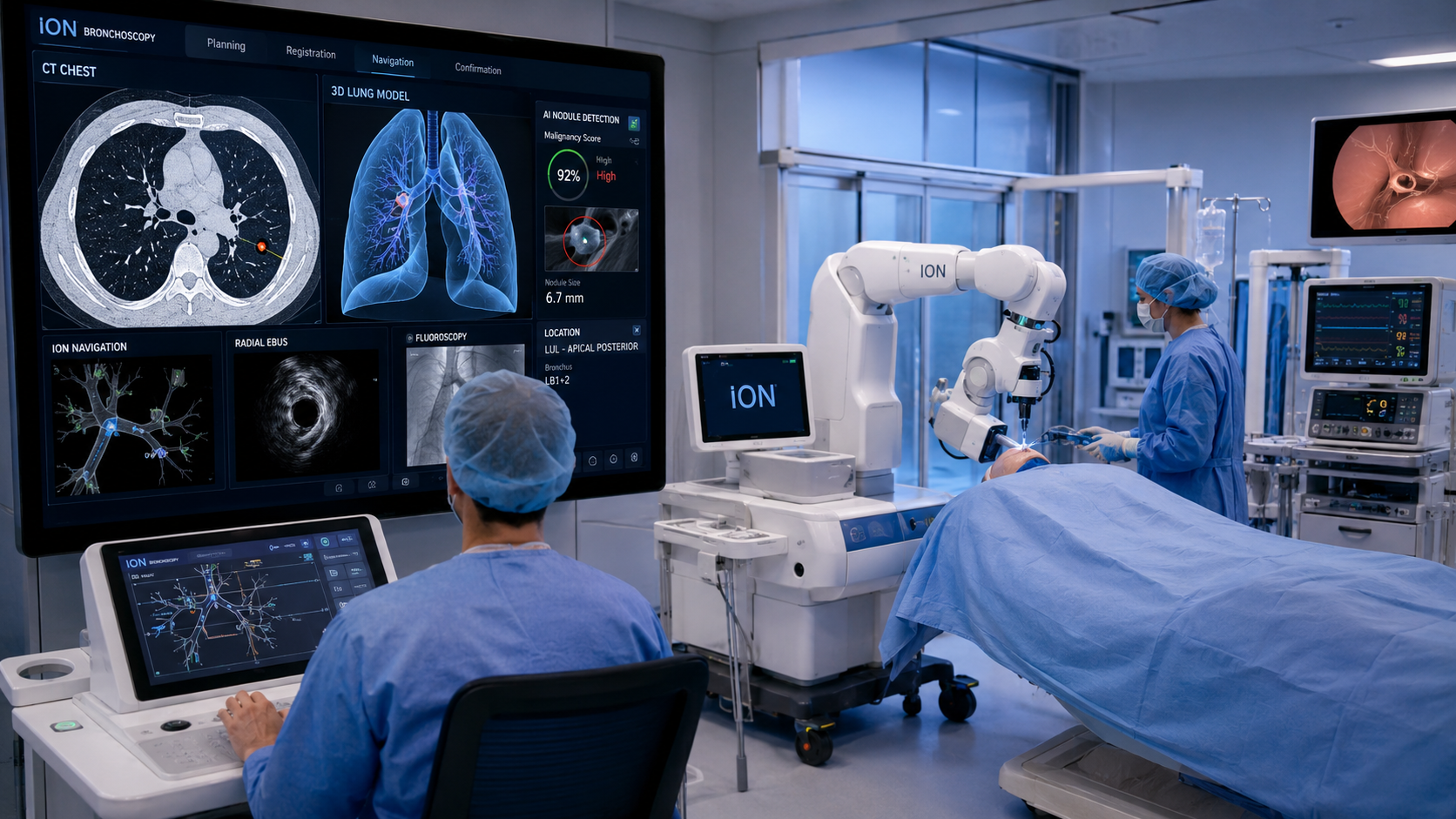
NHS England has launched a pilot that combines artificial intelligence with robotic technology to help doctors detect and diagnose lung cancer earlier. The system works in two steps: AI software rapidly analyses lung scans and flags small lumps most likely to be cancerous; then a robotic camera helps guide biopsy tools through the airways with greater precision than standard methods.
That may sound technical. It is actually deeply human.
Because for a patient waiting to know whether a shadow on a scan is cancer, time is not an abstract metric. It is fear with a calendar attached.
The NHS says the robot can reach nodules as small as 6mm – roughly the size of a grain of rice – hidden deep in the lung, where traditional methods can be difficult or risky. Once AI identifies higher-risk areas, doctors can take a precise tissue sample and send it to specialist labs for review.
This is where the story becomes bigger than one pilot.
The future of medicine may not arrive as one dramatic machine replacing the doctor. It may arrive as a chain of smarter interventions: AI sees what humans might miss, robotics reaches where hands cannot easily go, and clinicians make decisions faster with better evidence.
NHS England says the approach could replace weeks of repeat scans and procedures with a single half-hour biopsy for some patients. That is not just efficiency. That is less waiting, less uncertainty, less emotional torture disguised as “follow-up”.
The interesting part is not that AI is “helping doctors.”
That phrase has become almost boring.
The real shift is this: AI is entering the physical space of diagnosis. It is no longer only reading data. It is helping decide where a robot should travel inside the human body.
The future of healthcare may not feel like science fiction.
It may feel like getting an answer sooner.