The Robot Dentist Has Entered the Room. Please Try to Stay Calm
There are few places where humans feel less futuristic than the dentist’s chair. You lie back, open your mouth, hear a machine begin to scream, and suddenly civilization feels very fragile.
THE REVELATION
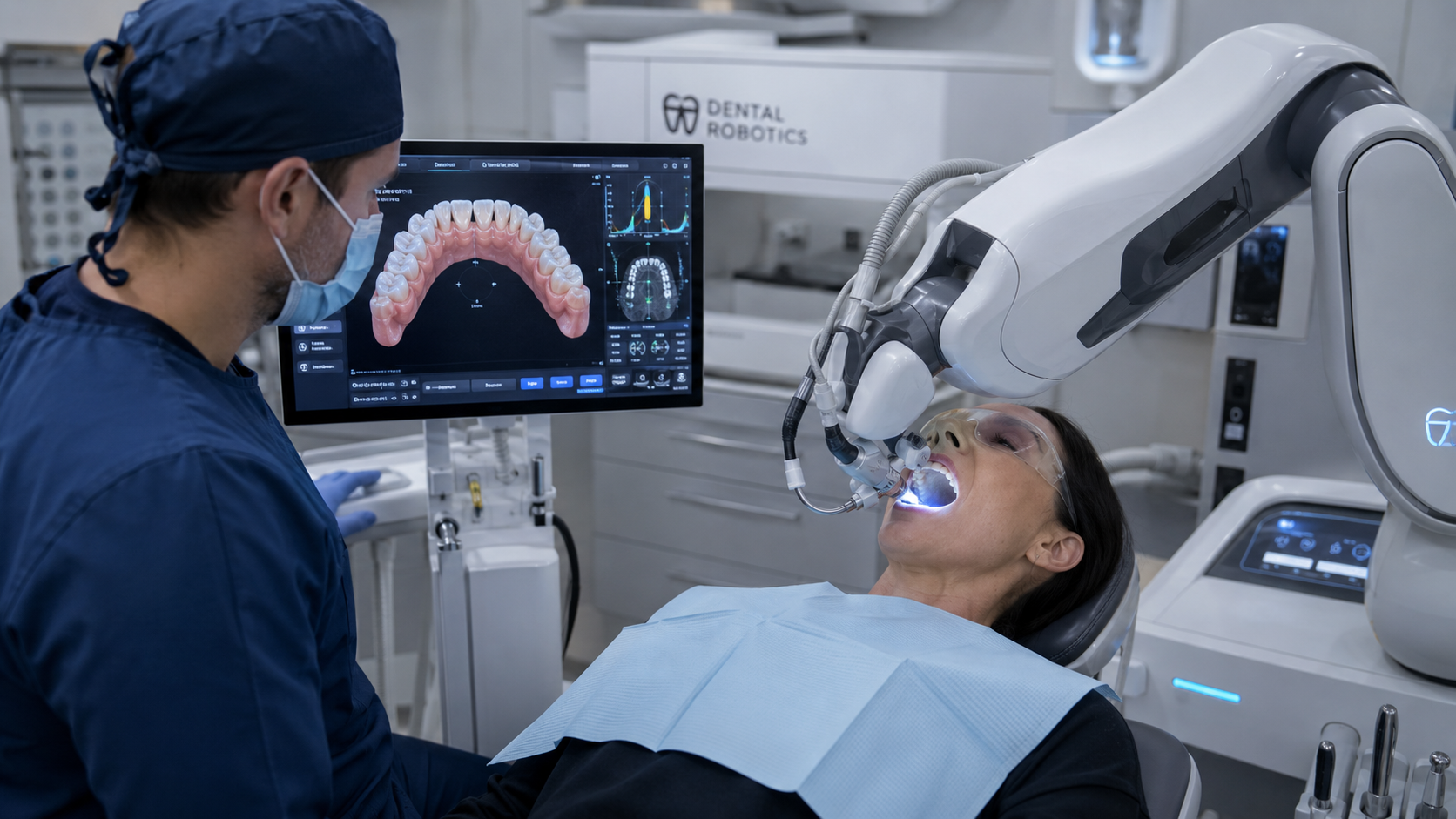
Robotic dentistry makes the automation question unusually intimate. It is one thing for AI to recommend a treatment or analyze an image; it is another for a machine to scan, plan and physically act inside a patient's mouth. Perceptive's system therefore points to a broader shift in healthcare automation: software is moving from advisory roles toward controlled physical execution. That does not necessarily remove the clinician. It changes where clinical judgment ends and machine precision begins. The challenge will be technical, regulatory and emotional at once, because in medicine a procedure can be accurate and still fail to earn trust.
There are few places where humans feel less futuristic than the dentist’s chair.
You lie back, open your mouth, hear a machine begin to scream, and suddenly civilization feels very fragile.
Perceptive, a Boston-based company working on automated dental technology, announced the completion of what it describes as the world’s first fully automated dental procedure on a human using an AI-driven robotic dentistry system. The system combines AI-powered 3D imaging software with a robotic arm designed to perform dental procedures, starting with restorative dentistry.
The company says the technology aims to reduce procedures such as crown placements to about 15 minutes, compared with the traditional process that can require two office visits of at least an hour each.
This is not a small cultural moment.
Dentistry is intimate, physical and psychologically loaded. People are not just afraid of pain. They are afraid of surrendering control. A robot entering that space changes the emotional contract between patient and care provider.
Perceptive’s system begins with an OCT scan of the tooth and mouth, capturing 3D images beneath the gum line, through fluids and under the tooth surface. AI algorithms then analyse the data and plan the procedure with high precision.
In other words, the machine does not simply “assist.” It sees, plans and acts.
That is why this story feels different from the usual healthcare AI announcement. It is not a dashboard. It is not a recommendation engine. It is not another “AI may improve outcomes” paragraph written for a pitch deck.
It is a robotic system performing a procedure on a human mouth.
There is a caveat: Perceptive notes that its dental robotics system and intraoral scanner are still under development, and the statements have not been reviewed by the FDA or another regulator.
Still, the direction is clear.
The future of dentistry may not replace the dentist completely. But it may change what the dentist does, what the machine does, and how much time we spend pretending to be brave under fluorescent lights.