Desert Rock: The Future of Hospitality Is Being Carved Into the Mountain
Most hotels are built on land. Desert Rock feels like it negotiated with the mountain first.
THE REVELATION
Desert Rock suggests that the next evolution of luxury may be specificity rather than excess. Its architecture does not attempt to neutralize the Hejaz Mountains into a generic resort backdrop. It makes the geology part of the room, the material language and the reason the hotel could not simply be reproduced somewhere else. That is a meaningful shift for hospitality. As premium properties converge on the same vocabulary of pools, spas and service, place itself becomes the scarce asset. The strongest hotel concepts may be those that cannot be separated from their landscape without losing their identity. Luxury becomes less about dominating nature and more about designing an experience that depends on it.
Most hotels are built on land.
Desert Rock feels like it negotiated with the mountain first.
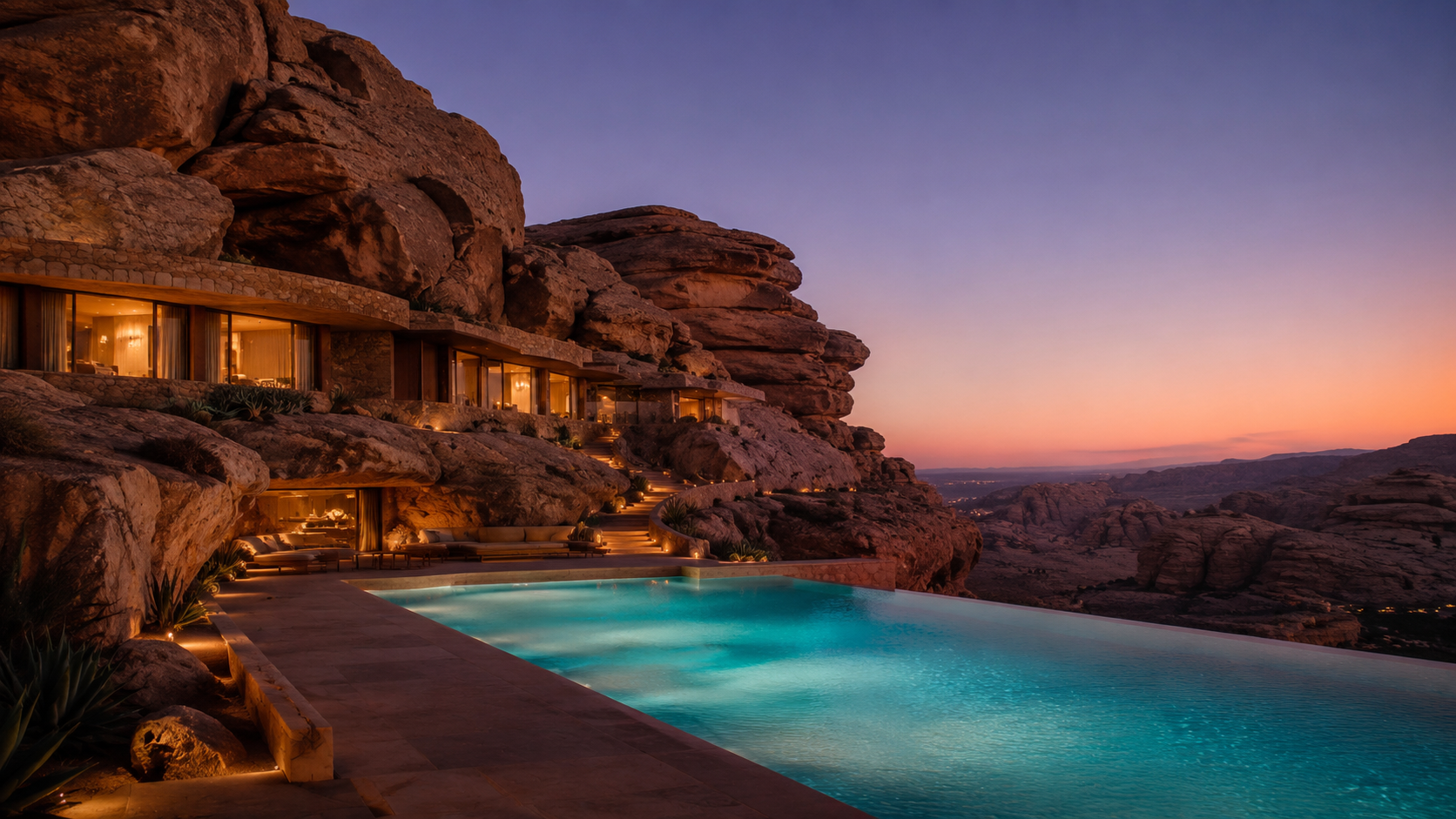
Located within Saudi Arabia’s Red Sea destination, Desert Rock is a luxury mountain resort set among the ancient rock formations of the Hejaz Mountains. The official resort site describes it as hidden within an untouched landscape, about 20 minutes from Red Sea International Airport, with pool villas and dining venues integrated into the rugged face of the mountain.
Red Sea Global describes the resort as offering 64 keys – 54 villas and 10 suites – set within the mountain, with uninterrupted views across the desert landscape, along with facilities including a spa, fitness center, remote dining areas and a lagoon oasis.
This is not the soft fantasy of desert luxury: a tent, a candle, a camel silhouette, and a brand deck saying “authenticity.”
Desert Rock is more architectural, more cinematic and more severe. It takes the drama of the landscape seriously. The point is not to decorate the desert. The point is to inhabit it without pretending humans are the main event.
Oppenheim Architecture, the firm behind the design, describes Desert Rock as a hospitality experience “nestled in the ancient mountains” and shaped in conversation with nature. Paolo Ferrari’s interior description notes Mountain Crevice and Mountain Cave Suites embedded into the landscape, following the contours of surrounding rock, with materials including hand-carved concrete, sandblasted wood and bespoke furnishings.
That material language matters.
The most futuristic thing about Desert Rock is not that it looks like tomorrow. It is that it refuses to look imported.
The future of luxury hospitality may not be universal. It may become more geological, more specific, more rooted in the land it occupies. The best hotels will not simply say “we are inspired by place.” They will make it impossible to imagine the same concept anywhere else.
Arab News described Desert Rock as set among mountains pockmarked with caves and noted that, unlike comparisons between Saudi Arabia and island resorts such as the Maldives, Desert Rock leans heavily into a landscape that feels singular. Wallpaper also included Desert Rock among notable 2025 hotel debuts, pointing to its geology-inspired design and sustainable luxury.
That is the real story.
Saudi Arabia is not only building luxury hotels. It is building a new geography of desire.
Shebara gives the Red Sea its sci-fi water fantasy. Desert Rock gives the desert its architectural mythology.
One floats like a mirror orb above the sea.
The other disappears into stone.
Together, they suggest that the future of hospitality in Saudi Arabia will not be one aesthetic. It will be a portfolio of impossible environments, each turned into a lifestyle proposition.
Desert Rock is not trying to make the mountain more luxurious.
It is trying to make luxury humble enough to enter the mountain.