Julia Upiterskaya Moderates AI Customer Experience Panel at Dubai AI Festival 2026
At Dubai AI Festival 2026, which brought together more than 20,000 attendees and leading figures from UAE business and global technology, JULS co-founder Julia Upiterskaya moderated a panel on how artificial intelligence is transforming customer experience, trust and brand relationships.
THE REVELATION
Artificial intelligence is giving brands unprecedented capacity to personalise and automate customer interactions, but greater technological capability does not automatically create stronger relationships. At Dubai AI Festival, where global technology leaders and UAE decision-makers gathered around ambitious plans for AI-driven growth, the panel moderated by Julia Upiterskaya examined a practical challenge: how to turn intelligent systems into meaningful customer experiences without sacrificing trust. As AI becomes part of everyday business operations, competitive advantage will depend not simply on how much companies automate, but on understanding where human judgement and connection remain indispensable.
As Dubai AI Festival gathered more than 20,000 participants, senior UAE officials and leaders of some of the world’s most influential technology companies, JULS co-founder Julia Upiterskaya moderated a discussion on how artificial intelligence is transforming the relationship between brands and their customers.
Dubai AI Festival 2026, held on October 26-27 at Dubai World Trade Centre, brought together more than 150 speakers, 500 investors and 200 exhibitors from over 100 countries. Organised by Dubai AI Campus, part of Dubai International Financial Centre (DIFC), in collaboration with the Office of the UAE Minister of State for Artificial Intelligence, the event reinforced Dubai’s position as a global centre for AI investment, innovation and adoption.
The festival’s opening was attended by H.H. Sheikh Hamdan bin Mohammed bin Rashid Al Maktoum, Crown Prince of Dubai, Deputy Prime Minister and Minister of Defence of the UAE, alongside senior officials including H.E. Omar Sultan Al Olama, UAE Minister of State for Artificial Intelligence, and H.E. Essa Kazim, Governor of DIFC.
During the event, Sheikh Hamdan approved new targets for Dubai AI Campus: attracting more than 1,000 AI companies and creating over 5,000 jobs by 2030. The campus had already attracted more than 500 companies and AED 1 billion in investment.
Where global technology meets UAE business leadership
The festival brought together an exceptional concentration of international technology executives and influential UAE business leaders.
Among its speakers were Hussain Sajwani, Founder and Chairman of DAMAC Properties; Muhammad Binghatti, Chairman and Chief Architect of Binghatti; Peng Xiao, Group CEO of G42; Mati Staniszewski, Co-Founder and CEO of ElevenLabs; and Arvind Jain, Founder and CEO of Glean.
The programme also featured senior representatives of Scale AI, du and the Mohammed Bin Rashid Space Centre, demonstrating how AI is moving beyond technology companies into real estate, telecommunications, government and other established industries.
Binghatti participated in a discussion on AI and the future of real estate, while California-based Scale AI announced its UAE presence through DIFC.
The significance of the gathering extended beyond its prominent names. Dubai was positioning AI not simply as an emerging technology, but as an increasingly central component of its economic and industrial future.
Julia Upiterskaya leads the conversation on AI and customer experience
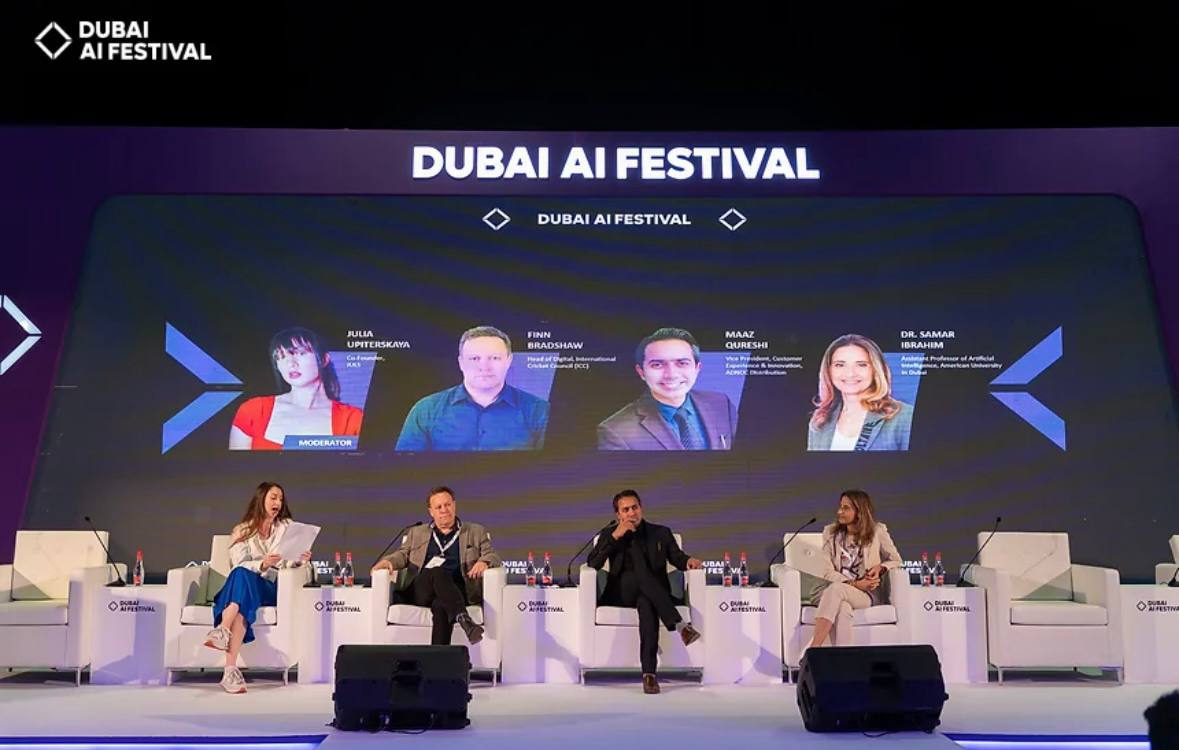
Within this high-profile international programme, Julia Upiterskaya, co-founder of JULS Global Communications House, moderated the panel How Brands Use AI to Redefine Customer Experience on October 27.
The discussion brought together three perspectives:
- Finn Bradshaw, Head of Digital at the International Cricket Council (ICC).
- Maaz Qureshi, Vice President of Customer Experience & Innovation at ADNOC Distribution.
- Dr. Samar Ibrahim, Assistant Professor of Artificial Intelligence at the American University in Dubai.
The conversation explored how AI is reshaping customer engagement, from personalised experiences and automation to data privacy, emotional intelligence and the changing role of human interaction.
For global organisations such as the ICC, AI presents new possibilities for engaging international audiences. For consumer-facing businesses such as ADNOC Distribution, its value must be measured against operational effectiveness, customer trust and real commercial outcomes. Academic research adds another dimension: understanding where intelligent systems improve human experience and where human judgement remains essential.
The central challenge is no longer whether brands can implement AI, but how they can use it without weakening the relationships they are trying to strengthen.
For JULS, which operates across strategic communications, brand positioning and business partnerships, the discussion reflected a broader transformation in how organisations build credibility and maintain meaningful connections with their audiences.
As Dubai accelerates its ambitions in artificial intelligence, the questions raised on this stage extend far beyond marketing. They concern the future of trust, communication and the relationship between technology and people.