Quantum Computing Is Finally Trying to Be Useful – Starting With Medicine
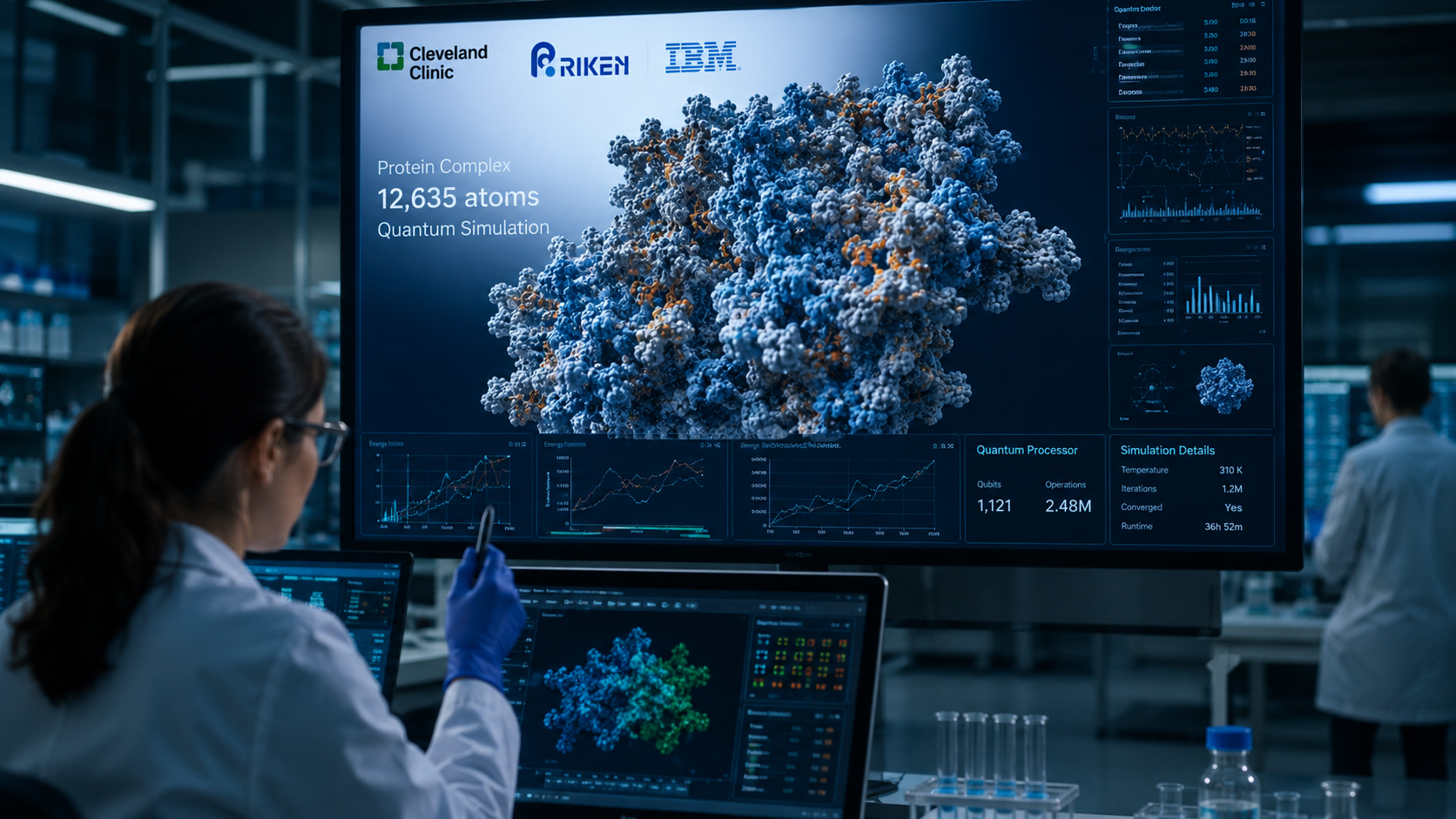
Researchers from Cleveland Clinic, RIKEN and IBM have modeled a protein complex containing 12,635 atoms, using quantum computers alongside two of the world’s most powerful supercomputers.
THE REVELATION
Quantum computing will become easier to take seriously when its advantages attach to problems whose complexity already defeats ordinary intuition. Molecular biology is a natural test because proteins and their interactions are exactly the kind of systems that become computationally overwhelming. The Cleveland Clinic, RIKEN and IBM work does not mean quantum hardware has suddenly transformed drug discovery, but it moves the conversation toward biologically meaningful workloads. The real milestone for quantum computing will not be a larger machine or a more impressive benchmark. It will be the moment researchers can ask a medical question that classical computing could not answer well enough - and receive something useful in return.
Quantum computing has spent many years sounding like a technology invented primarily to make investors nod slowly at conference panels.
But medicine may be where the abstract finally becomes intimate.
Researchers from Cleveland Clinic, RIKEN and IBM have modeled a protein complex containing 12,635 atoms, using quantum computers alongside two of the world’s most powerful supercomputers. The work has been described as one of the largest biologically meaningful molecular simulations performed with quantum hardware.
The Financial Times reported that quantum computing is moving closer to drug discovery through enzyme studies involving biological molecules of around 12,000 atoms.
The point is not that quantum computers are suddenly about to cure everything. They are not. The industry still has more caveats than a luxury real estate brochure.
But this is a meaningful signal.
Drug discovery is one of the places where better simulation could change everything: how researchers understand proteins, how they test molecular interactions, how they reduce expensive trial-and-error processes, and how quickly new therapies might move from theory to reality.
Quantum computing has always promised to calculate what classical computers struggle to handle. Biology, inconveniently, is full of exactly that kind of complexity.
The body is not a spreadsheet. It is a living system of interactions, probabilities and molecular choreography.
If quantum computing becomes useful there, it may finally stop being “the future of computing” and start becoming the future of survival.