Dream Labs Wants Robot Intelligence to Travel Between Machines
Dream Labs has paired a $90 million seed round with Dream-1 and a public API designed to send robot observations and plain-English instructions into physical actions. The bet is that robot intelligence can become portable software rather than machine-by-machine code.
THE REVELATION
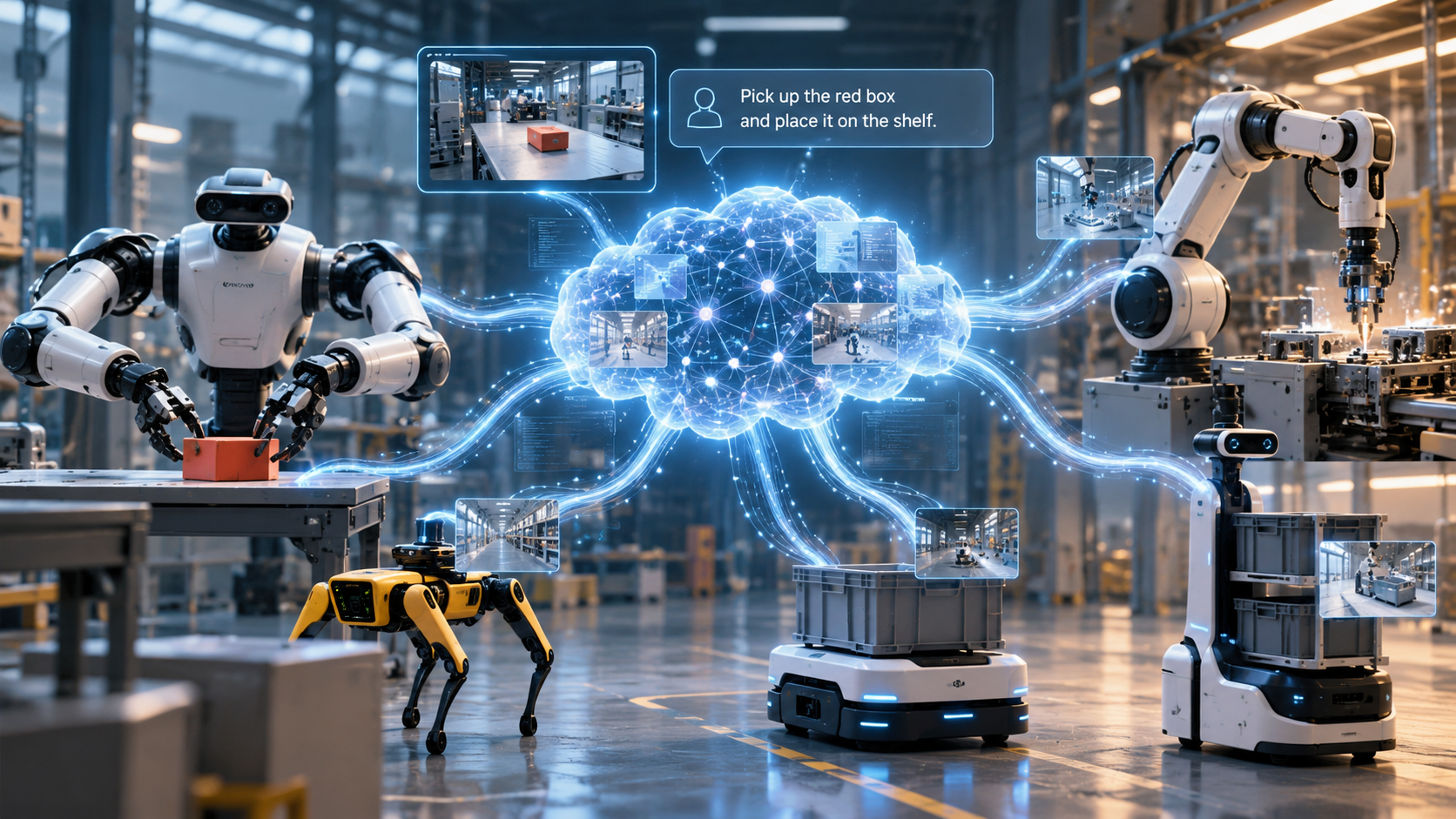
Dream Labs is turning robot intelligence into a metered software service. Dream-1 and Dream API are designed to take robot observations and plain-English instructions and return actions, making the company’s central bet unusually concrete: intelligence should move between machines instead of being rebuilt for every robot. The launch is ambitious, but the evidence needs careful handling. Dream Labs reports zero-shot evaluations across four real and 27 simulated robots, while related DreamZero research reports gains in generalization and embodiment adaptation. Those findings do not independently validate every Dream-1 product claim. The unresolved question is whether portability survives unfamiliar hardware, task variation and production constraints - especially in a world where the IFR counts approximately five million industrial robots already operating globally.
Robotics has spent years asking how to make machines more capable. Dream Labs is asking a sharper question: what if the intelligence did not belong to the machine at all? The company has emerged from stealth with Dream-1, a World Action Model, a reported $90 million seed round and a public product called Dream API.
Dream API accepts robot observations and task instructions, then returns actions. Dream Labs says the system is aimed at bimanual robots with parallel grippers and can address robots and tasks it has not previously encountered. Kindred Ventures describes the interface more simply: a robot camera feed and a plain-English instruction become motor commands.
From machine-specific code to a shared layer
That proposition shifts the commercial story. Instead of treating every robot as a separate programming project, Dream Labs is packaging control as an API that developers can access by the hour. Dream-1 is announced at $3 per hour, while the lighter Dream-1-flash is priced at $2 per hour; the company says each call returns approximately 1.6 seconds of actions.
The timing gives the pitch a large industrial backdrop. The International Federation of Robotics reported approximately five million industrial robots in operation worldwide in 2025, alongside 9% growth and more than 600,000 installations during that year. If robot intelligence becomes a shared service, the opportunity is not just to sell another model. It is to sit between many machines and the people trying to make them useful.
The evidence is promising – and still qualified
Dream Labs reports zero-shot results on four real and 27 simulated robots, while noting that performance varies with robot configuration and inverse-kinematics quality. The company’s product claims therefore come with an important boundary: this is reported evaluation evidence, not independent validation across every robot or task.
The related DreamZero paper provides a technical foundation for the idea. It describes a World Action Model built on a pretrained video-diffusion backbone that jointly predicts future video states and robot actions. The authors report more than a twofold improvement in generalization against cited VLA baselines in real-robot experiments, 7 Hz closed-loop control for a 14-billion-parameter model, and adaptation results using limited video or play data. Those are research findings about DreamZero, not direct proof of every Dream-1 product promise.
The financing and the API launch make the infrastructure thesis legible: robotics may be moving toward a market where intelligence is rented, updated and shared. But the decisive test will happen away from the launch page – on unfamiliar hardware, under changing conditions and with the constraints that make real-world automation less photogenic. A robot API is easy to price. Reliability is the product still waiting to be proven.
Sources: International Federation of Robotics — “Five Million Robots now Operate in Factories Globally”; arXiv — “World Action Models are Zero-shot Policies”; SiliconANGLE — “Dream Labs raises $90M to help build more intelligent robots with simple video feeds”; LHC — “Dream-1: An AI capable of controlling robots it has never encountered”; Dream Labs — “Zero-Shot to New Robots: Introducing Dream-1”; Kindred Ventures — “Dream Labs: Building the Brain for Everyday Robots”