Humanoid Robots Are Learning to Use Their Hands. This Is Where It Gets Personal
French startup Genesis has unveiled an AI model for robots and a human-like robotic hand designed to mirror human anatomy more closely than standard grippers.
THE REVELATION
Robotic intelligence becomes materially more consequential when it reaches the hand. Locomotion makes a robot mobile, and language makes it interactive, but dexterity gives it access to the countless physical tasks on which daily life and industry depend. Genesis is focusing on that boundary: transferring human skills into a hand that can manipulate fragile, irregular objects with touch and timing. The breakthrough to watch is therefore not whether humanoids look convincingly human. It is whether they can handle the physical world with enough precision and adaptability to be useful outside tightly controlled environments. Dexterity is where embodied AI stops observing and starts participating.
For years, robots were mostly impressive in the way gym equipment is impressive: strong, expensive and emotionally distant.
But the real future of robotics was never just about lifting boxes. It was about hands.
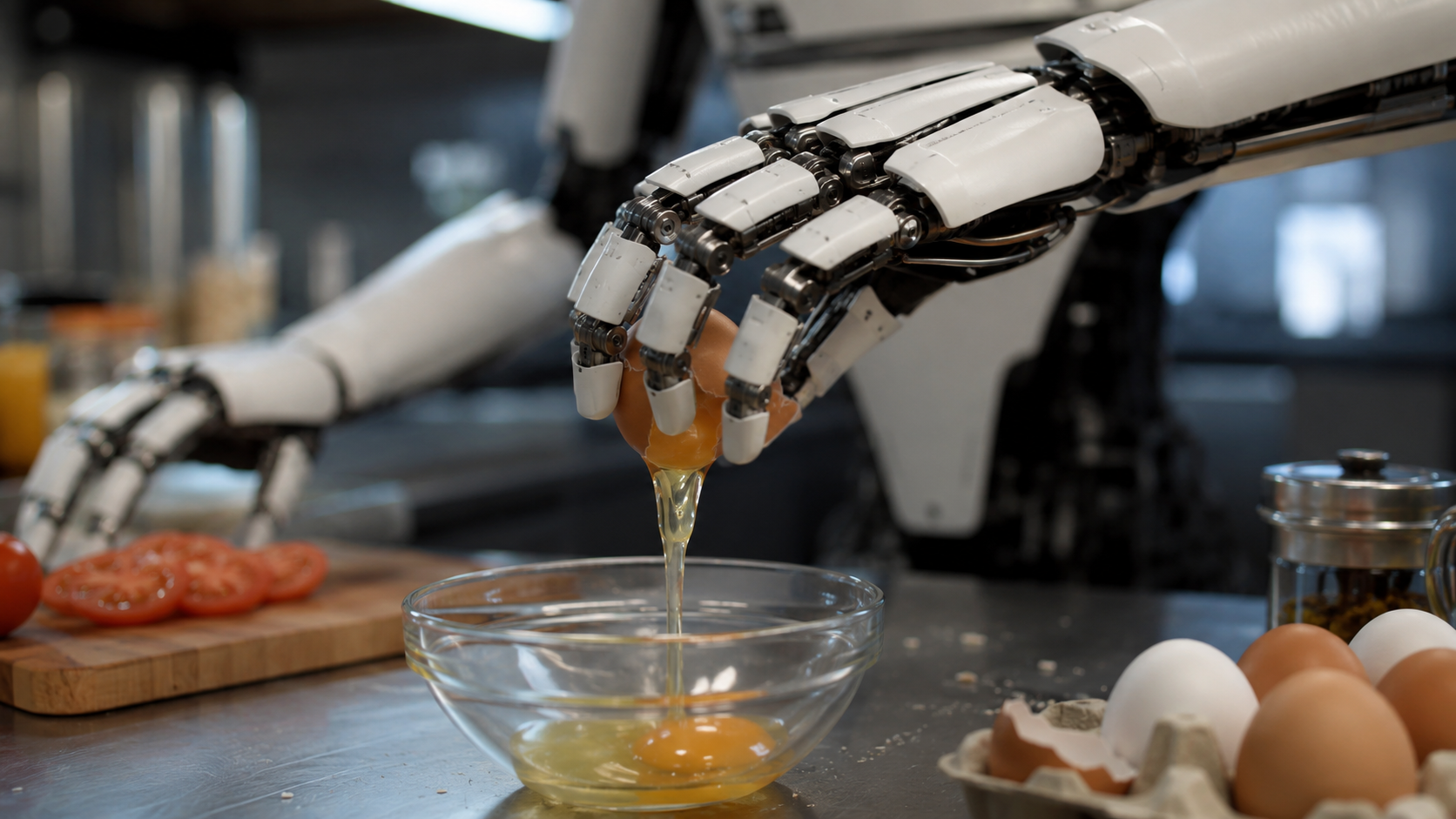
French startup Genesis has unveiled an AI model for robots and a human-like robotic hand designed to mirror human anatomy more closely than standard grippers. In a video seen by Reuters, the robot hand cut tomatoes, cracked eggs, solved a Rubik’s Cube and played the piano.
The company describes its system as combining a dexterous robotic hand with a data engine that helps transfer human physical skills to machines.
That may sound like a cute demo until you remember that most of human civilization depends on hands.
Cooking, assembling, repairing, cleaning, caregiving, surgery, manufacturing, art, music, the small domestic gestures that make life feel human – all of them require dexterity. Not just intelligence. Not just vision. Touch, pressure, timing, adaptation.
A chatbot can write a mediocre email in seconds. But a robot that can crack an egg without destroying breakfast is crossing a much stranger border.
The robot future will not begin when machines look like us.
It will begin when they can touch the world like us.
And once that happens, the conversation shifts from “Can robots think?” to something far more uncomfortable:
What happens when they can do?