SAP’s Warehouse Robots Are Not a Demo. They Are Folding Boxes
The future of work probably will not enter the office wearing a silver suit. It may arrive in a warehouse, fold a box and ask for no applause.
THE REVELATION
Physical AI may enter the economy through the least cinematic tasks first. Box folding, packaging and fulfilment look mundane, but they expose robots to the variability that has kept much warehouse work stubbornly human. SAP and Cyberwave's deployment matters because the robots are not being presented as a laboratory promise. They are operating inside an active logistics workflow and learning to generalize across objects and conditions. That points to a practical threshold for embodied AI: not human likeness, but adaptability. Once robots can handle disorder without weeks of task-specific engineering, automation begins to move from fixed machinery toward a more flexible labor layer.
The future of work probably will not enter the office wearing a silver suit.
It may arrive in a warehouse, fold a box and ask for no applause.
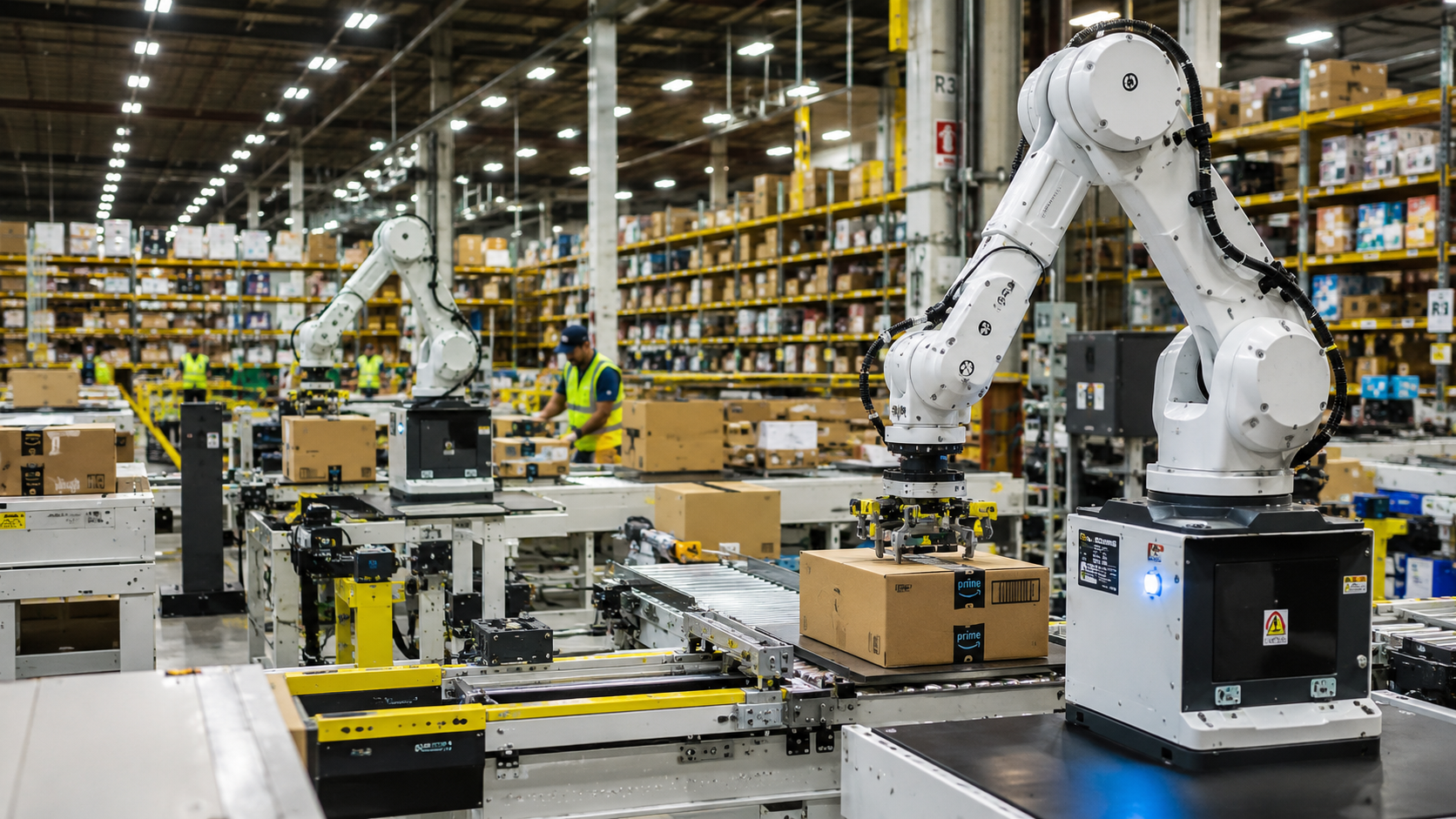
SAP and Cyberwave announced the deployment of fully autonomous AI-powered robots inside an active SAP logistics warehouse in St. Leon-Rot, Germany. The robots operate on SAP Logistics Management and perform box folding, packaging and in-house shipping fulfilment fully autonomously.
That phrase – “fully autonomously” – is doing a lot of work here.
Because logistics is not a clean lab environment. Warehouses are messy. Objects vary. Boxes move. Labels change. Workflows shift. Humans improvise constantly, usually without getting invited to innovation panels for it.
Cyberwave’s platform uses real-world training data, Vision-Language-Action models and Reinforcement Learning to help robots generalize across different objects, orientations and workflows rather than simply memorize scripted motions. The company says traditional robotic systems often require weeks of engineering per task, while its approach can reduce training time from weeks to hours.
This is the kind of AI implementation that matters precisely because it is not glamorous.
A robot folding boxes does not sound like science fiction until you remember how much of the global economy depends on repetitive physical work that is difficult to automate well.
SAP frames the deployment as proof that Physical AI is no longer just a research concept. At its St. Leon-Rot warehouse, the robots are already being used in live operations, freeing human workers from repetitive, physically demanding tasks and increasing throughput.
The cultural shift is simple: AI is leaving the screen.
It is not only writing emails, generating images or summarizing meetings. It is entering warehouses, touching objects, adapting to disorder and becoming part of the operational backbone of companies.
The future of AI may be less glamorous than we imagined.
It may be very good at tape, cardboard and labels.
And that may be exactly why it works.