Paraíso Wants Latin American Art to Enter London on Its Own Terms
London’s new Paraíso fair places Latin American art at the centre of its own platform, pairing a geographically broad programme with Felipe Ehrenberg’s postal conversation across borders.
THE REVELATION
Paraíso gives Latin American art something London’s global fair circuit does not automatically provide: a space to frame the region on its own terms. Its first edition suggests that visibility is not only about getting artists into the room, but about controlling the context in which their work is understood. Felipe Ehrenberg’s postal practice makes that idea especially clear: connection itself can become part of the artistic infrastructure. Whether Paraíso turns that framing into lasting institutional or market influence is still unproven, but the more important proposition is already visible — representation is also about who gets to define the conversation.
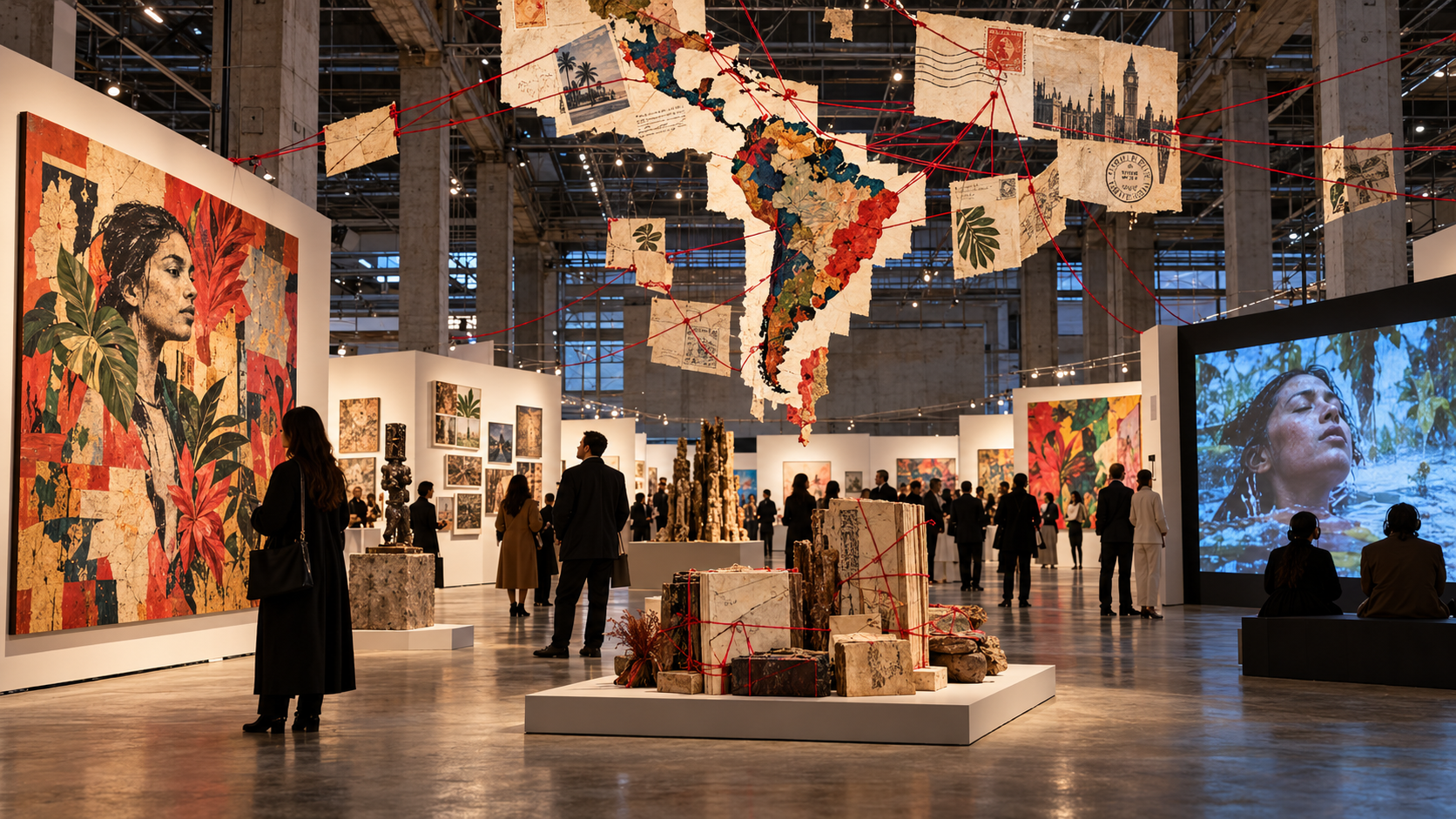
London’s art calendar already knows how to become crowded. Paraíso entered it during Frieze Week with a more specific proposition: a dedicated fair for Latin American art, held at Ambika P3 from October 15 to 18, 2026. Its first edition was not presented as a single-country showcase, but as a platform bringing together 22 international galleries and projects.
The geography mattered. Reports on the fair described participants from Bogotá, Lima, Santiago de Chile, Santa Cruz and Mexico City, alongside London galleries focused on the region. The programme moved across painting, installation, photography, sculpture and conceptual practices. Mexico served as the opening focus country, with presentations including the work of Felipe Ehrenberg and video works by Pola Weiss.
A fair built around connection
The fair’s strongest conceptual anchor was “Felipe Ehrenberg: 26 Maculate Letters from Mexico | An Unfinished Conversation.” The presentation brought together 26 works by the Mexican artist, whose practice here was rooted in letters sent through the postal system. Correspondence was not merely the subject of the project; it functioned as its medium and method, linking Britain, Mexico and an international network of artists.
That history gives the presentation an unusual resonance inside a contemporary fair. Ehrenberg’s postal practice was connected to his arrival in Britain in 1968 and to his interest in the British postal service. The London presentation had originally been planned for 2016 but was never realised. The evidence does not establish why. What it does show is a work returning to London through the very logic it explored: distance, exchange and the persistence of artistic networks.
Visibility is the unfinished part
Javier Calderón, Paraíso’s founder and the person who established Somers Gallery in King’s Cross in 2015, described the fair as a response to Latin America’s need for its own voice in London’s art ecosystem. That is Calderón’s stated rationale, not an established market consensus. Still, it clarifies the fair’s ambition: not simply to add regional artists to an existing circuit, but to create a frame in which their geographic and artistic connections remain visible.
Whether Paraíso changes London’s art market, attracts new institutions or builds lasting audiences cannot yet be concluded from this first edition. For now, its significance lies in the question it places in public: can a fair create genuine visibility without flattening a complex region into a single visual identity? Ehrenberg’s unfinished conversation suggests that the answer may begin not with a louder display, but with better connections.
Sources: Paraíso Latin American Art Fair — official homepage; Paraíso, 2026 — Cecilia Brunson Projects; Felipe Ehrenberg — Paraíso Latin American Art Fair; About — Paraíso Latin American Art Fair; Artists to Watch at Paraíso, London’s new Latin American Art Fair; Debutó Paraiso Fair, la primera feria de arte latinoamericano en Londres — Chaco y su Gente; Frieze Week London 2026 Fairs — Biennale