The Factory Is Becoming Software With Moving Parts
Teradyne's investment in Bright Machines points to a shift from isolated automation tools toward coordinated production systems for AI infrastructure - though the proposed integration remains an evaluation, not a proven deployment.
THE REVELATION
The next industrial revolution may be defined less by smarter machines than by the disappearance of the boundaries between them. When assembly, testing, logistics and production data begin to operate as one coordinated system, the factory stops behaving like a collection of equipment and starts behaving like software. Teradyne and Bright Machines are not there yet - their collaboration is still an evaluation - but the direction is revealing. As AI hardware becomes more complex and product cycles become shorter, the competitive frontier may shift from who owns the best robot or test system to who can orchestrate the entire physical production layer as one programmable environment. The factory is becoming an operating system for the physical world.
AI infrastructure does not begin in a data center. It begins on a factory floor, where servers, racks and storage systems have to become physical products. Teradyne's investment in Bright Machines matters because it treats that floor less like a collection of machines and more like a coordinated software system.
Announced on October 5, 2026, the transaction combines a strategic investment with a strategic collaboration. The financial details remain undisclosed: neither the amount, ownership percentage, valuation nor terms were provided. A separate MarketScreener report, citing S&P Capital IQ, said Bright Machines issued convertible preferred stock to Teradyne, but also supplied no amount or percentage.
Not just another robot in the corner
The companies say they will evaluate bringing Teradyne robotics and test technologies into Bright Machines manufacturing environments. The proposed use cases are concrete: precision robotic assembly, loading and unloading test equipment, and autonomous movement of materials. In other words, the ambition is not simply to add a robot arm and hope the factory feels smarter.
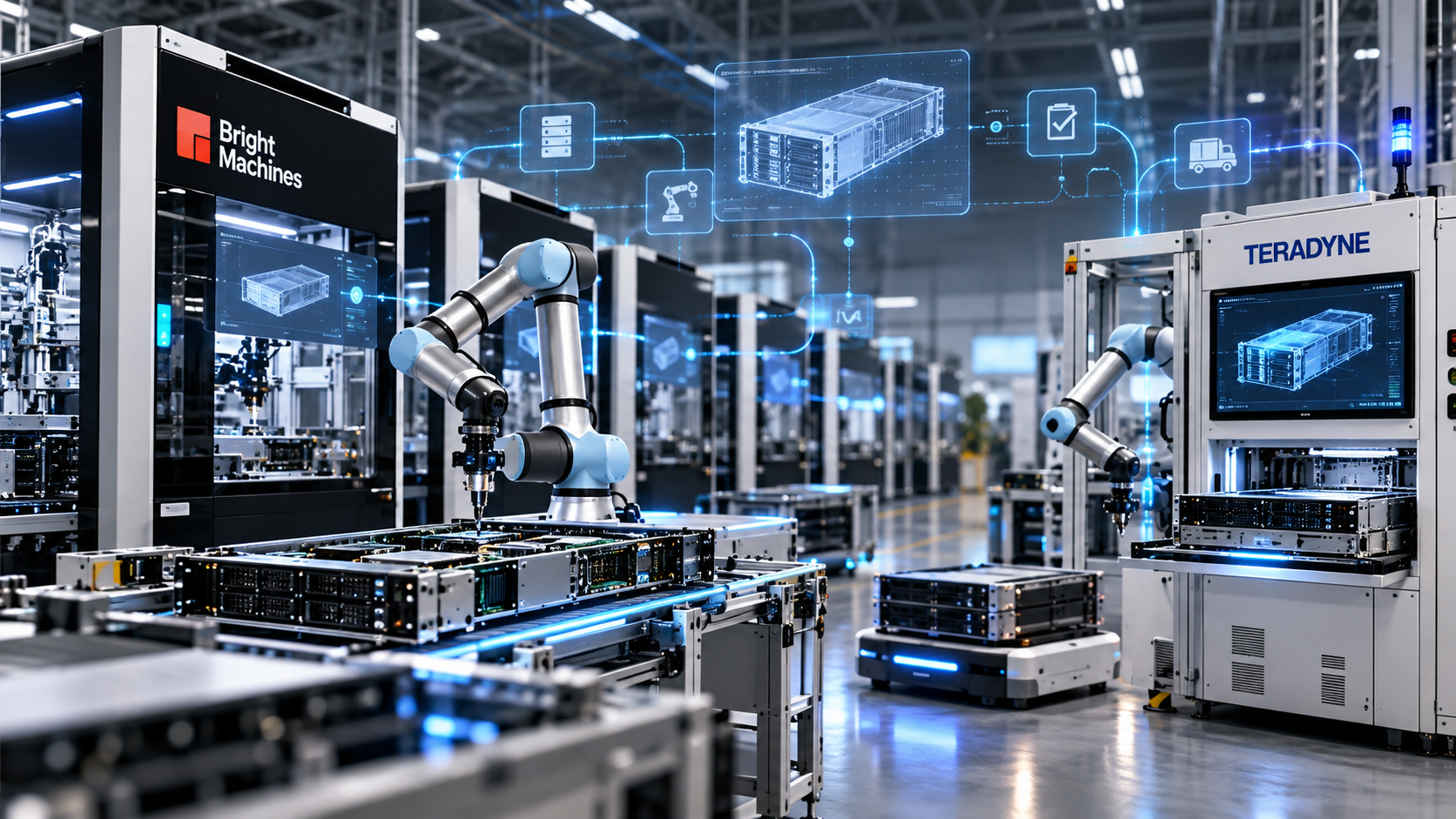
The proposed setup would connect Bright Machines' manufacturing platform with Universal Robots collaborative robots and Teradyne board-test systems. The companies describe a shared layer linking assembly and inspection data, robot and material-movement data, electrical-test results, product genealogy and manufacturing intelligence.
That architecture is the interesting part. Bright Machines describes Bright Factory as a platform that connects design through deployment, with capabilities including data orchestration and traceability. It also identifies itself as a manufacturer of data-center infrastructure for hyperscalers using software and robotics. Teradyne, meanwhile, markets automated testing and robotics for AI-device, semiconductor, electronics and data-center workflows.
The promise is coordination, not magic
If the proposed integration works in practice, its value could sit in the connections between tasks. Assembly, testing, movement and product history would no longer be treated as separate islands. That could make production more traceable and easier to reconfigure – at least in principle. The factory starts to look less like a room full of equipment and more like a programmable operating layer for physical goods.
There is also a larger signal here. As AI infrastructure expands, the manufacturing system behind it becomes part of the technology story. Teradyne brings robotics and automated test; Bright Machines brings a software-defined production platform. Together, the companies are positioning coordinated automation as infrastructure for building infrastructure.
But the announcement is not proof that this system is already operating at commercial scale. The collaboration is described as an evaluation, not a completed integration. Bright Machines says it has deployed more than 130 microfactories across more than 10 countries, yet that figure is company-reported and the supplied evidence contains no independent operating-performance data. Its claims of 40% faster time to revenue, 30% lower total cost and 15% higher reliability also lack methodology, sample size and independent validation in the available material.
The real story, then, is not that Teradyne and Bright Machines have solved AI-hardware manufacturing. It is that the factory is being designed as a connected technical system – one where robots move, machines test, software coordinates and data remembers. The future of AI infrastructure may depend not only on what the hardware can compute, but on how intelligently the factory can make it.
Sources: Bright Machines, Inc. announced that it has received funding from Teradyne, Inc.; Teradyne Makes Strategic Investment in Bright Machines to Advance AI Infrastructure Manufacturing; Bright Machines homepage; About Us — Bright Machines; Artificial Intelligence — Teradyne